


Motion in the Fossil Record
- Molly Mannion
- Nov 10, 2018
- 3 min read
Updated: Apr 30, 2019
Dr Peter Falkingham is a paleontologist from Liverpool John Moore University conducting ground-breaking research in the locomotion of extinct theropods or more comonly known as the dinosaurs.
His research explores focuses on the use of trace fossils, which are footprints, tracks or any piece of information left behind by an animal, rather than the animal itself. These fossils become buried in sediment and harden over time to create fossils.
This is an interactive, 3D model of a footprint, created from a real trace fossil found in Texuas, USA.
Allen, 1997 found that when mud is depressed, the deformation is transmitted outwards and causes displacement in the layers below the surface. This suggested to Dr. Falkingham that the layers below the surface of the mud held key information about the movement of dinosaurs.
Hitchcock in 1838 was the first to suggest the idea of footprints below the surface of mud but he did not establish this or connect it to dinosaur locomotion.
Did you know, birds are the less evolved version of dinosaurs!
Both of these key findings suggested some key questions for Dr. Falkinham's research:
1. What factors contribute to track morphology?
2. How has the evolution of birds changed track fossils?
3. How can we understand dinosaur locomotion from tracks?
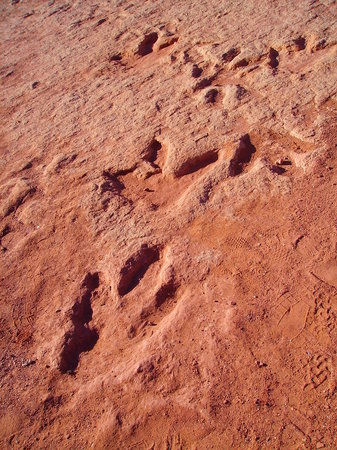
What factors affect track morphology?
Tracks are characterised by three key factors:
1. Substrate, the type of ground the track is formed on and it's consistency.
2. Anatomy, the size of the foot, number of toes and the presence of claws or scales.
3. Dynamics, how the foot moves through the substrate, change in weight distribution and the motion of the knees and hip.
The Beneski Museum of Natural History in Massacheusetts holds the best record of trace fossils, according to Dr Falkingham.
If we understand how a track is made by we can reverse engineer it to understand what environment the extinct animals lived in, the soft tissue of the organisms and how they moved in their environment.
Evolution and bird tracks
The next question he addresses is how did evolution alter the track fossils. Birds evolved from dinosaurs, with many changes in morphology and physiology along the way, including the altering of musculature and bone structure.

The femur in particular is a key alteration in birds, with dinosaur femurs being vertical, whereas bird femurs are horizontal. In addition to this, the difference in tail musculature also poses a significant difference between birds and dinosaurs. Dinosaurs possess a large, thick muscular tail that they use to aid their movements, whereas birds do not possess this feature.
With these differences, Dr Falkingham proposed a comparison between the movement of birds to the movements of dinosaurs.
It later occurred to him that no research had yet been done on the movement of birds, which took a detour to explaining the research conducted to explore guinea fowl foot movement below the surface.
The final question
How can we understand locomotion from tracks? Utilising the information on the evolution, bird motion and track morphology we can finally establish the motion of dinosaurs using novel technologies including XROMM (X-ray reconstruction of moving morphology) and DEM (a model that simulates foot-substrate interactions). These technologies fill gaps in knowledge of trace fossils.

My experience
Dr Falkingham's research was fascinating from start to finish, and his explanations were easy to understand and grasp from any background of knowledge. His research expanded my knowledge of research methodologies and novel techniques available to modern science. I have also expanded my interests in the field of zoology to explore aspects of paleontology by purchasing some reading material on dinosaurs. It has also inspired some thought into investigating the fossils of temnospondyls and lissamphibia, the ancestors of amphibians where my main focus currently lies.
There's little known empirically on these fossils and this opportunity to discuss and explore this research with Dr. Falkingham or researchers he knows has furthered my career expectations.


Comments